
It should not be an account biography copied from a company website. A long history can be useful, but it does not create a growth strategy. Salesforce describes account plans as a place to research accounts, set objectives with actionable measures, and track growth. The practical test is whether a manager can read the plan and decide where the team should spend time this month.
Account planning is a decision document, not an account biography
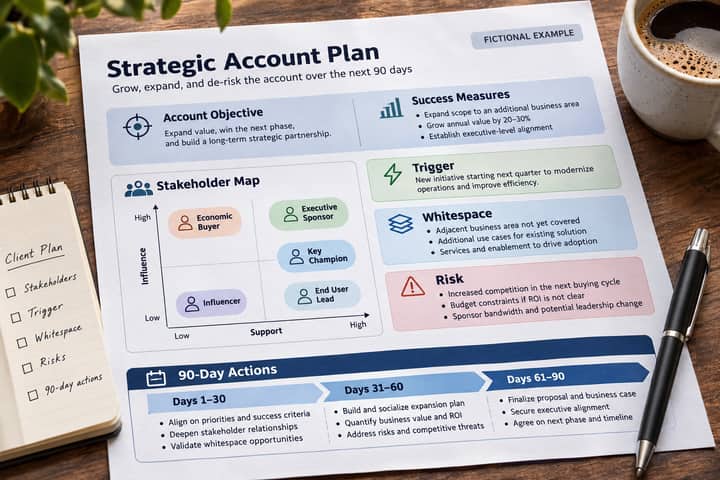
Keep one account plan to one working page. Link to supporting research rather than pasting everything into the plan.
The plan should answer five questions:
- What business outcome matters to the account now?
- What event makes action timely?
- Which stakeholders shape, approve, or block the decision?
- What value and whitespace are supported by evidence?
- What mutual action will happen next, who owns it, and by when?
If a field cannot change what the team does, remove it. Account planning is a choice about attention.
Pick the accounts that deserve planning effort
Do not create strategic plans for every account. Choose accounts where a coordinated plan can change the result.
Ask whether the account is important enough to justify cross-functional time, whether there is a credible business issue or trigger, whether the team can create a differentiated position, whether whitespace might matter to the buyer, and whether the team can reach more than one relevant stakeholder.
An account with large revenue but no active business issue may need retention management, not a growth plan. An account with a strong trigger but weak access may deserve a discovery plan first. Label the current motion honestly: retain, expand, recover, or qualify.
Avoid an invented scoring formula. If you use a score, define each input and keep the underlying evidence visible. A high score without stakeholder access is not strategy.
The six fields of a strategic account plan
Business priorities and trigger events
Write the account’s current business priority in the buyer’s language. Then record the event that makes the priority actionable: a new executive, expansion, cost pressure, system change, product launch, regulatory requirement, or missed operational target.
Do not call a generic annual priority a trigger. “Growth” is not a trigger until a concrete change creates a decision, owner, or deadline.
Stakeholder map and power path
Map the people who experience the problem, influence the evaluation, approve the investment, implement the change, and can block it. Record the relationship and evidence for each.
The map should expose the power path. Which person can make the project real? Who must be convinced? Who has a veto? Who pays for the problem if nothing changes?
One enthusiastic user is not a multi-threaded account. A multi-threaded plan has several relevant relationships connected to a shared business outcome.
Current account-planning value, whitespace, and proof
Record what the account already buys or uses, the outcome it associates with that work, and what remains unaddressed. Whitespace is a hypothesis until the buyer confirms a need.
Use proof from account conversations, usage, service history, public business information, or agreed outcomes. Do not assume a product category is a need because the company is large.
Competitive position and no-decision risk
Competition includes named providers, internal work, existing tools, and doing nothing. Write what the buyer compares and why your approach is relevant.
No-decision risk deserves its own line. The account may agree with the problem but lack a sponsor, budget, implementation capacity, or urgency. State which condition is missing.
Mutual actions
A seller’s task is not a mutual action. “Send proposal” is internal. “Customer operations lead validates the target workflow with finance and seller returns with implementation options on 18 July” is mutual.
Record the next action, both owners, date, and evidence of completion. This prevents account plans becoming internal wish lists.
Account planning risk and decision
State the biggest risk to the account objective and the decision required from the team. For example: “We have strong user access but no economic buyer path. Decide whether to invest in an executive workshop this month.”
The plan is strongest when it helps a manager stop low-value activity.
The one-page account plan template
| Field | Working entry |
|---|---|
| Account outcome | Expand into finance workflow, if the buyer confirms the control issue |
| Strategic trigger | New finance transformation lead started in April |
| Stakeholder | Operations sponsor, finance approver, IT evaluator |
| Evidence | Sponsor described manual reconciliation in discovery |
| Current relationship | One sponsor, no finance access |
| Next mutual action | Sponsor and finance lead validate the workflow on 18 July |
| Owner | Account executive and sponsor |
| Risk | Project is an unfunded improvement idea |
This is a fictional example. Replace every field with account evidence before using it.
Build a 90-day account action plan
Break the plan into three 30-day horizons. Use each period to earn the next evidence.
Days 1–30: establish the business issue
Confirm the trigger, outcome, and stakeholders. Test whether the problem is active and whether someone owns it. If access is weak, make the first objective a relevant introduction rather than a product pitch.
Days 31–60: create a shared case
Connect the buyer’s priority to an operational or financial consequence. Agree on decision criteria, required proof, and implementation conditions. Engage people who can approve or block the initiative.
Days 61–90: earn a decision
Run the agreed evaluation, resolve commercial and technical risks, and confirm the decision process. If the buyer cannot commit to a decision, reclassify the opportunity instead of extending the plan indefinitely.
The dates are planning scaffolding, not a forecast guarantee.
Run the monthly account review
Use a 30-minute review for each priority account:
- What changed in the account’s business situation?
- Which stakeholder relationship improved, weakened, or remains unknown?
- What evidence supports the growth or retention hypothesis?
- Which mutual action was completed?
- What is the next decision and who owns it?
- Should the account remain strategic for the next month?
Challenge activity that has no account outcome. A sequence of meetings can look busy while leaving the power path untouched.
Avoid common account-planning failures
The first failure is planning from the seller’s product catalogue. Start with the account’s priority and trigger. Map the solution later.
The second is confusing contacts with relationships. A CRM contact is not evidence of influence. Record what the stakeholder has said or done.
The third is writing a plan once per quarter and ignoring it. Review evidence monthly. An account plan is a live decision document.
The fourth is spreading effort across too many accounts. Strategic planning requires cross-functional attention. If the team cannot act on the plan, reduce the portfolio.
The fifth is treating expansion as inevitable. Existing revenue proves a relationship, not a future need. Revalidate value and priority before adding whitespace.
The C-level dictionary helps sellers frame account outcomes in executive language. The projects overview provides an internal path when the account issue points to broader commercial transformation.
Illustrative plan example with assumptions labelled
Assume a software company has an existing account in one department and sees a possible expansion into finance. The seller knows the operations sponsor, but has not met finance or IT. The sponsor mentions a manual control process, but no baseline or deadline exists.
The correct plan does not say “finance expansion in Q3.” It says:
> Hypothesis: the finance workflow may have a control problem worth solving. Evidence: sponsor described manual reconciliation in a discovery conversation. Unknowns: baseline effort, finance ownership, budget, and decision date. Next mutual action: sponsor validates the workflow with finance and returns with an owner and decision path.
That wording stops a hopeful expansion idea becoming pipeline and tells the manager what to inspect next.
FAQ
Make the page earn its place
Choose a small group of accounts. Write the outcome and trigger in buyer language. Map the power path. Make every whitespace claim carry evidence or an explicit unknown. End with a mutual action and date.
If account plans expose gaps in sales leadership or coverage, start with the projects overview or sales leadership assessment services. The value of account planning is the decision it improves this month.
What is account planning in B2B sales?
Account planning is a structured decision document for a priority customer. It connects business priorities, trigger events, stakeholders, current value, whitespace, risks, and mutual next actions.
How many accounts should a team plan?
Plan accounts that justify coordinated attention and where the team can act on evidence. The number depends on account complexity, manager capacity, sales motion, and available resources. A smaller active set is usually more useful than a large passive library.
What belongs in a key account plan?
Include the account outcome, trigger, stakeholder and power path, current value, whitespace hypothesis, competitive and no-decision risk, mutual action, owner, date, and next decision.
How often should account plans be reviewed?
Review priority plans monthly and update them whenever a material trigger, stakeholder, decision criterion, or commercial risk changes. A quarterly review alone is too slow for an active expansion motion.
What is the difference between account planning and a sales plan?
An account plan focuses on one customer’s business situation and growth path. A sales plan covers the team or territory, including targets, capacity, coverage, and execution priorities. They should connect, but are not interchangeable.