
Frontline managers often mix four conversations into one meeting: forecast inspection, deal coaching, skill coaching, and the career 1:1. The forecast takes the time, the manager gives advice on the biggest deal, and the rep leaves without a specific behaviour to practise.
Gong recommends a recurring coaching routine and focused review of calls or feedback. The operating lesson is simple: coaching needs a regular owner, a defined observation, and a follow-up observation. The manager does not need to comment on every weakness. One behaviour, practised and observed, is more useful than fifteen suggestions.
Coaching is a management system, not an occasional rescue
Training gives people information. Coaching helps them apply it in a real situation.
The manager’s weekly job connects three things:
- Evidence: what the seller did or failed to do.
- Impact: what that behaviour changed for the buyer or deal.
- Replacement: what the seller will do next time and how it will be observed.
“Be more consultative” is too vague. “After the buyer described the approval delay, you moved to the demo without asking what the delay would cost the project. Next call, ask one implication question before proposing a solution” is coachable.
Separate the four conversations managers keep mixing
Forecast inspection
Forecast asks whether the revenue number is credible. It examines evidence, stage, close date, buying process, and risk. It should not become a skill lecture in the middle of a deal.
Deal coaching
Deal coaching asks what action could improve one opportunity. It might involve stakeholder mapping, a business case, a mutual action plan, or an executive meeting. The output is a next move on a live deal.
Skill coaching
Skill coaching addresses a repeatable behaviour across opportunities: opening a call, asking implication questions, validating a metric, handling a commercial objection, or confirming the decision process.
Career 1:1
The career conversation covers growth, motivation, workload, capability goals, and support. It should not disappear because this week’s pipeline is difficult.
These conversations can happen in the same week, but they should have distinct purposes and notes. If every 1:1 is a deal review, the manager is managing opportunities rather than developing a seller.
The weekly sales coaching 1:1 agenda
Use a 30-minute 1:1 and adjust the duration to the role and context.
Rep-owned opening, five minutes
Ask the rep to set the agenda. What needs attention? Where are they stuck? Which commitment from last week is complete? This gives the manager information about judgement and ownership before advice starts.
One evidence-based skill focus, ten minutes
Bring one observation from a call, email, deal note, or stage pattern. Ask the rep what they noticed first. Then agree on a replacement behaviour. Do not turn the section into a lecture. Ask the rep to explain what they will say or do differently.
One live deal, ten minutes
Select the deal because it teaches something or carries material risk. Inspect the next buyer action, not every CRM field. If the deal needs a forecast decision, move that part to the forecast conversation.
Commitments and next observation, five minutes
Write down the behaviour, practice situation, owner, and date of the next observation. The manager owns follow-up. A coaching action that is not observed is advice, not a coaching cycle.
Choose the sales coaching target from evidence
Use four sources:
- Competency model: capabilities the role requires.
- Call or meeting notes: observable behaviour in buyer conversations.
- Stage conversion: where opportunities stall or regress.
- Live observation: what the manager sees in a call, deal review, or customer meeting.
Do not infer a skill gap from one bad outcome. A lost deal can result from fit, timing, competition, or buying-group change. Look for a repeated behaviour or a credible moment where the seller had control.
The internal sales competency model supplies useful language. Use the SPIN selling questions guide when discovery is the coaching target, but translate the method into an observed action.
A four-week coaching cycle
Week one: diagnose
Review an observation and agree on the specific behaviour. Define what good looks like in a buyer interaction. Record the current example without turning it into a personality judgement.
Week two: model
The manager demonstrates the behaviour through a role play, call opening, question sequence, or written example. Keep the model close to the seller’s market and motion.
Week three: practise
The seller practises with a realistic scenario. The manager gives feedback on one or two points. Gong’s guidance similarly recommends focused feedback rather than a long list the seller cannot apply.
Week four: observe
Listen to a call, join a meeting, or inspect the next relevant deal note. Record what changed and whether the next cycle should continue, change, or close.
The cycle does not promise a particular commercial uplift. It creates a repeatable way to observe behaviour and decide what to do next.
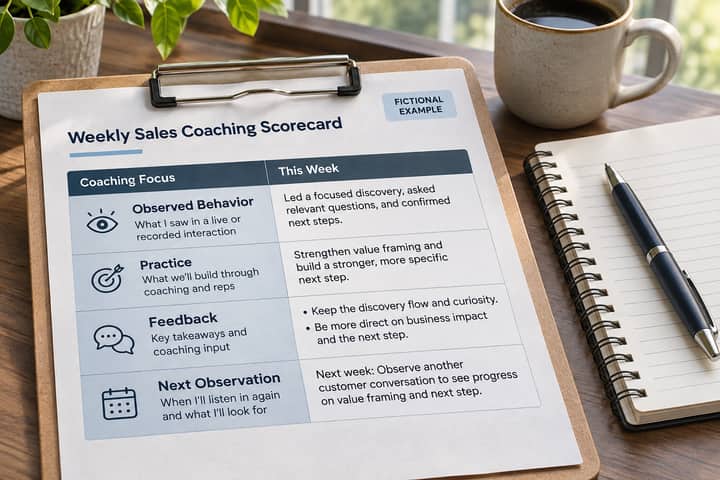
The weekly coaching sheet
| Field | Entry |
|---|---|
| Observed behaviour | Seller answered a pricing question with a feature list |
| Impact | Buyer did not explain the commercial concern |
| Replacement behaviour | Ask what the buyer must justify internally |
| Practice scenario | CFO asks for a price reduction after a demo |
| Next observation | Next pricing call or role play by 24 June |
| Owner | Seller, with manager follow-up |
The entries are illustrative. A useful sheet is short enough to complete during the meeting. Do not create surveillance theatre with a note for every sentence a rep says.
Document feedback without creating surveillance theatre
Document the work so the rep can use it and the manager can follow up. Describe behaviour, context, impact, and the agreed replacement.
Good documentation:
> In the discovery call on 10 June, the buyer described a delayed handoff. The seller moved to a demo before testing the operational consequence. We agreed to ask one implication question before presenting a solution. We will review the next recording on 17 June.
Poor documentation:
> Needs to listen better and be more strategic.
Use coaching data to improve the management system, not to create an activity leaderboard. Useful adoption measures include whether 1:1s occur, whether a focus behaviour is recorded, whether a follow-up observation happens, and whether the seller can explain the replacement behaviour. These show management activity and learning progress. They do not prove revenue causation.
Measure coaching quality without invented uplift claims
Track three layers:
- Routine: Did the manager hold the planned coaching conversation?
- Behaviour: Did the seller demonstrate the replacement behaviour in an observed situation?
- Commercial context: Did the relevant deal or stage move, and what other factors may explain it?
Do not promise that a coaching cadence will increase win rate by a fixed percentage. If you want to study impact, define the period, population, behaviour, and comparison before starting. Record confounding factors such as territory, segment, product change, seasonality, manager change, and pipeline mix.
The site’s C-level dictionary helps managers align coaching language with executive outcomes. A broader diagnostic can test whether managers have the capability and time to run the system.
FAQ
Start with one behaviour per manager
Pick one behaviour that appears in the competency model and buyer evidence. Run the four-week cycle. Keep notes specific, protect the rep’s ownership, and review the next observation before adding a new focus.
When managers need help diagnosing leadership capability, use the sales leadership assessment service. A coaching system works only when frontline managers have clear expectations, enough observation time, and a reason to follow through.
What is sales coaching?
Sales coaching is a manager-led process that uses observed selling behaviour to build a more effective replacement behaviour. It includes diagnosis, practice, feedback, and later observation. It is different from general training.
How often should sales managers coach?
Use a recurring weekly routine for active development, then adjust frequency to the role, experience, and evidence. A consistent shorter cycle is easier to sustain than a large monthly event.
What belongs in a sales manager 1:1?
The rep’s priorities, one evidence-based skill focus, one relevant live-deal discussion, and clear commitments. Keep forecast administration and career planning distinct, even when they happen in the same week.
How is coaching different from pipeline review?
Pipeline review inspects opportunities and forecast risk. Coaching develops the seller’s behaviour. A deal can be the context, but the output should be a behaviour to practise and observe.
How do you measure coaching quality?
Measure whether the routine happens, whether the seller practises the behaviour, and whether later observation shows it. Treat commercial outcomes as contextual evidence, not automatic proof of coaching impact.